ARCHAI WORLD™

ARCHAI WORLD | ENTERPRISE TRANSFORMATION

Architect the enterprise.Deploy its AI workforce.Govern every decision.Prove the value.

Move from fragmented AI experiments to an architecture-led enterprise transformation. Connect strategy, specialized AI employees, authorized business context, governance, workforce capabilities and measurable economic results.

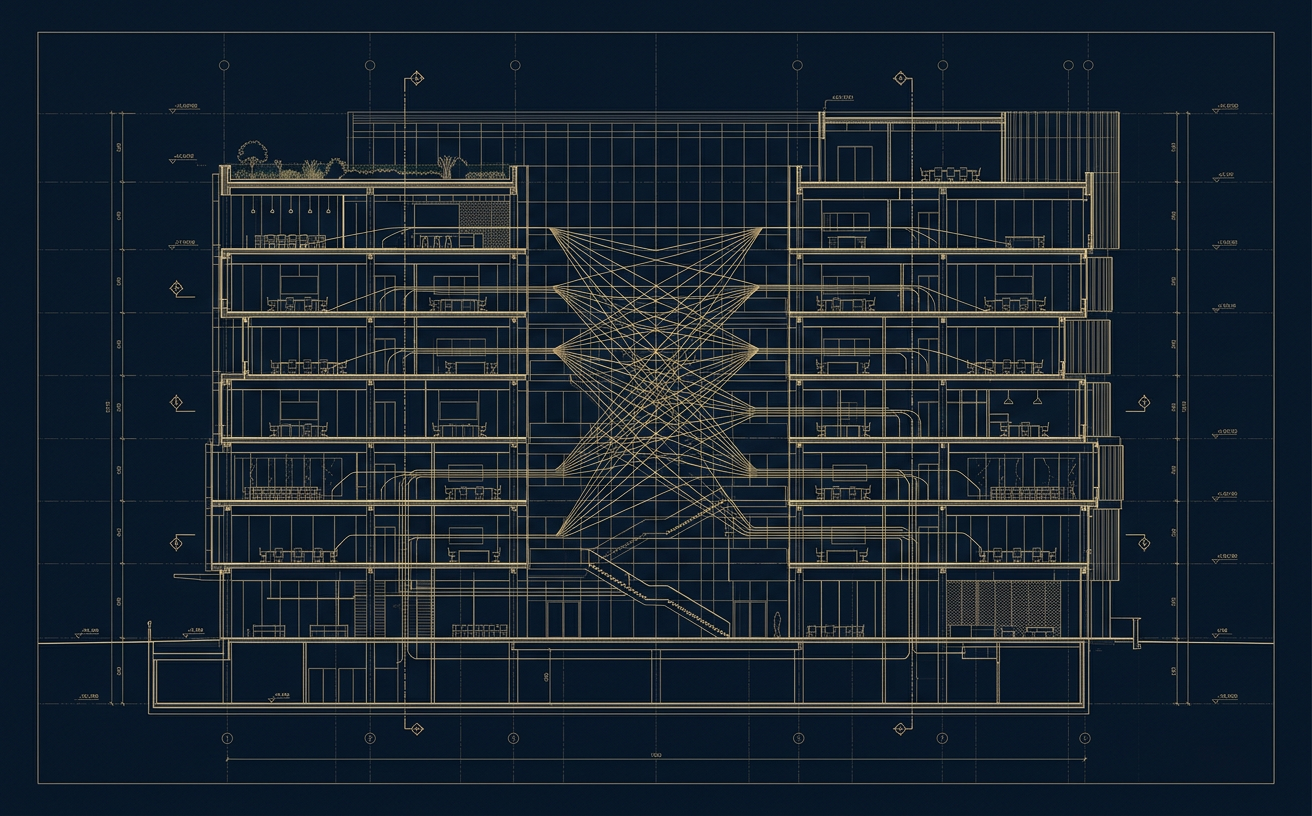
Architectural blueprint of an enterprise headquarters with layered floors connected by fine gold lines
Architecture first. Authority designed. Evidence kept.

The business problem

AI Investment Is Growing.
Enterprise Accountability Must Keep Up.

Four gaps recur wherever AI is adopted faster than it is governed. Each one is a leadership decision, not a technology problem.

  1. AI initiatives disconnected from enterprise architecture

    Teams launch pilots in isolation. Without a shared view of systems, dependencies and decision rights, each experiment adds integration debt instead of enterprise capability.

  2. Agents without assigned authority and accountability

    An agent that can act needs a named owner, clear limits and an escalation path. When authority is implied rather than designed, risk is accepted by default.

  3. Training with no operational application

    Workshops build awareness, but capability only compounds when people apply it to real workflows, with supervision responsibilities that outlast the course.

  4. AI spending without a credible financial baseline

    If current effort, cost and quality are not measured first, no later result can be defended in front of a CFO or an audit committee.

One connected transformation model

From Business Ambition to Reviewable Outcomes.

Five stages, each handing a defined output to the next, so every step can be reviewed by the executives accountable for it.

  1. 1

    ASSESS

    Enterprise Agentic Readiness & ROI Blueprint

    Identify business priorities, architecture dependencies, governance gaps and value opportunities.

  2. 2

    ARCHITECT

    ARCHAI Core + Enterprise Architecture

    Define decision rights, operating boundaries, context and target-state design.

  3. 3

    DEPLOY

    ARCHAITECTS AI Employees + ARCHAI WORLD Studio

    Configure specialized DOTs and mission-based execution.

  4. 4

    GOVERN

    AI Governance + Evidence Lab

    Assess permissions, controls, operational risks, traceability and human oversight.

  5. 5

    SCALE

    ARCHAI WORLD University + Enterprise Agent Operating Office

    Build the organizational capability to supervise, improve and scale the transformation.

The Enterprise Agent Control Plane is a strategic design vision that guides this work. It is not an already delivered standalone software product.

Four commercial offers

Start where the decision is. Scale where the evidence is.

Each offer has a defined purpose, defined deliverables and a clear boundary. They can be bought in sequence or separately.

A10-business-day assessment

Enterprise Agentic Readiness & ROI Blueprint

Pilot price

US$4,997

A structured assessment that turns a broad AI ambition into a prioritized, evidence-based investment roadmap before any build begins.

Deliverables

  • Executive opportunity brief
  • Architecture and dependency review
  • Candidate agent mission register
  • Risk and governance gap assessment
  • Prioritized investment roadmap
  • Business-value baseline
B30 days

30-Day Governed Agent Mission Pilot

Starting at

US$19,997

One scoped business mission, designed with explicit permissions and human approval, configured in approved tooling and measured against a baseline.

Deliverables

  • One scoped business mission
  • Architecture and permission design
  • Configured workflow in approved tooling
  • Acceptance test and human-approval design
  • Measured pilot results
  • Next-stage scale recommendation
C

Enterprise Agent Operating Office

From

US$7,500/month

A standing executive cadence that keeps agent missions accountable: oversight of the mission portfolio, architecture and governance reviews, and measured performance.

Deliverables

  • Agent mission portfolio oversight
  • Governance and architecture reviews
  • Performance measurement
  • Lifecycle and change controls
  • Executive operating cadence
D

AI Agent Governance & Evidence Lab

Starting at

US$9,997

An independent examination of the agents you already run or plan to run: what they can reach, how autonomous they are, and whether the evidence exists to defend their decisions.

Deliverables

  • Agent inventory and risk-tier review
  • Access and autonomy assessment
  • Human oversight and escalation testing
  • Evidence sufficiency review
  • Governance findings and action plan

All pricing shown is proposed starting or pilot pricing and is subject to a statement of work.

Solutions by executive role

The same transformation, read through the role that owns the risk.

Select a role to see what it needs from an agentic enterprise and the offer we would start with.

Strategic execution and enterprise value

Tie every AI investment to a strategic outcome you can inspect.

  • See which AI initiatives support stated strategy and which are experiments.
  • Require a baseline and a measure before capital is committed.
  • Know who is accountable for each mission that acts on the enterprise.

The ARCHAI ecosystem

Four properties. One distinct responsibility each.

ARCHAI WORLD is the parent frame. Each property carries a different part of the transformation, so nothing is asked to do a job it was not built for.

ARCHAI WORLD

Foundation

ARCHAI Core

The architecture foundation beneath all four properties: decision rights, operating boundaries and authorized context.

Explore ARCHAI Core

90-day enterprise value path

Ninety days from baseline to a scaling decision.

This is an illustrative engagement sequence, not a guarantee of results. Actual scope and timing are set in a statement of work.

  1. 1

    Days 1-10

    Evaluate and baseline

    Confirm priorities, review architecture and dependencies, and establish the business-value baseline.

  2. 2

    Days 11-30

    Design and deploy initial mission

    Scope one mission, design permissions and approvals, and configure the workflow in approved tooling.

  3. 3

    Days 31-60

    Stabilize, validate and measure

    Run acceptance tests, observe the mission in operation and measure it against the baseline.

  4. 4

    Days 61-90

    Review economics, controls and scaling decision

    Examine economics and control evidence with executives, then decide whether and how to scale.

Economic model

Test the arithmetic with your own assumptions.

Enter your figures to see how the economics of one workflow could look. The starting values are editable placeholders, not results from any company.

hours

Total across everyone involved

US$

Salary, benefits and overhead per hour

%

Your own assumption, 0 to 100

US$

One-time, over the evaluation period

US$

Recurring services, software and usage

months

Whole months, 1 to 60

Scenario output

Estimated monthly gross capacity value
$9,000
Estimated total cost over the evaluation period
$50,000
Estimated net benefit
$58,000
Estimated ROI
116%
Estimated payback period
3.1 months

Illustrative scenario only. Time savings are not automatically cash savings. Results depend on adoption, quality, avoided costs and the use of released capacity.

Case evidence

The structure every mission is reported in.

Each engagement is documented in the same eight parts, so a sponsor, a CFO and an auditor can read the same record and reach their own conclusion.

Executive evidence dossier with floor plans, a financial ledger and a brass pen on a dark desk

Illustrative scenario — not a client result

Problem
The business decision or workflow that is not performing, described in the sponsor’s words.
Baseline
Measured effort, cost, cycle time and quality before any agent is introduced.
Authorized sources
The systems and documents the mission may read, each with a named data owner.
Mission
The scoped job given to a specialized AI employee, with its owner and boundaries.
Controls
Permissions, human-approval points and escalation paths that limit what the mission can do.
Decision
Who decides what, which recommendations are reviewed and what is recorded.
Measurement
The same measures as the baseline, collected over the evaluation period.
Business outcome
The observed change, stated with its limits, and the resulting scale decision.

This is a template of the reporting structure. It describes no real company, customer or result.

Questions executives ask

Straight answers before a first conversation.

How is this different from buying another AI platform?

We begin with the enterprise decision and the architecture around it, not with a product. Platforms are chosen after missions, authority and controls are defined, and the work is designed around tooling your organization has approved. We do not ask you to adopt a new platform as a precondition.

How does it work with an existing enterprise architecture team?

It is designed to work alongside your architects. We use the architecture you already maintain as the reference for dependencies, decision rights and target state, and the deliverables are intended to feed your architecture practice rather than replace it.

Do we have to replace our systems?

No. Missions are designed to work with the systems you already operate. If an assessment reveals a dependency that blocks a mission, we report it as a finding and let you decide how to address it.

Which data and permissions may an agent access?

Only what is explicitly authorized. Each mission has a register of authorized sources with named owners, a defined permission set and human-approval points for consequential actions. The Governance & Evidence Lab can then test whether actual access matches what was authorized.

What does the pilot actually deliver?

One scoped business mission, the architecture and permission design behind it, a configured workflow in approved tooling, an acceptance test and human-approval design, measured pilot results and a recommendation on the next stage. It delivers evidence about one mission, not an enterprise-wide rollout.

How is value measured?

Against a baseline captured before the mission runs, using the same measures afterwards. We distinguish released capacity from realized savings: time saved becomes cash only if the freed capacity is redirected or costs are actually avoided. The calculator on this page illustrates the arithmetic only.

Are software costs included?

Offer prices cover the professional services described for each offer. Third-party software, licences, platform usage and infrastructure are separate and are identified in the statement of work. All pricing is proposed and subject to that statement of work.

How do training and corporate services connect?

Capability building is part of the model rather than an add-on. ARCHAI WORLD University develops the people who will supervise agent missions, while the Operating Office gives them an executive cadence in which to apply that capability. Training is scoped with the engagement, not sold as a substitute for it.

Start with one consequential business decision.